A long, long time ago, in a galaxy far, far away, a social and economic experiment occurred that was so successful and on such a grand scale, that we should all be riding on the ripples of the tsunami it created. But we're not. I decided to try and figure out why. First, a little background.
In the late 1800's a strapping young shoe maker with a God given talent for what we might call today "industrial engineering" (making industry more efficient) and personal skills found himself in quite a pickle. Having received a letter offering him a supervisor position at the Lester Brothers Shoe Company, he borrowed ten dollars from his older brother and made his way towards Binghamton, New York. On the trip, his collar and tie were stolen while he slept on a boat from New England. He walked the last dozen miles or so, covering him with dust. He stood in front of the factory supervisors for his interview only to be informed they were looking for an older man by the same name, his father. And to top it off, he only had eight cents in his pocket, not nearly enough to get home to his family. George F. Johnson needed this job. And he got it!
From the position of managing a "tree room" (supervisor to a crew of men making boots on shoe trees) he rose to obtain the number two job in the company. Through repeated process innovations that made his room the most productive in the factory, and the personal skills where every member of his team felt he was treated fairly and honestly, he began a meteoric rise to the very heights of the world wide shoe industry.
One day, his boss, the Lester Brothers asked if George F. had any suggestions about building a new factory to handle the demand for high quality products his teams were cranking out in ever increasing numbers. And of course he did. He suggested buying cheap farm land away from the dirt and grime of urban life. Wide open spaces, fresh air, green fields, plenty of land for the workers to buy plots and build houses. His theory, later described as the "Square Deal" was that if workers felt part of the enterprise, well respected, treated fairly, comfortable, and knowing their families were also happy and content, then they would be more productive, increasing profits, to allow his dream to grow. And it did.
The Lester Brothers followed George F.'s advice, and built the factory in what was then called Lestershire. But when it came to plots for workers houses, they were greedy, carving up tiny lots, and sold them for exhorberant fees. In fact they made so much money they neglected the shoe business and concentrated on land speculation. And as fate would have it, they lost most of their fortune in land speculation, and so George F. found himself with a new boss, the Lester Brother's largest debt holder, one Harry B. Endicott, a Boston millionaire who traded in real estate and tanning hides, for among other purposes, shoe and boot leather.
One day Endicott came to the shoe factory for a visit and was astounded by what he found. Happy workers, digging into their work with amazing proficiency. Every worker at the factory personally knew George F. And he made sure he knew every worker, not just as a manager, but as a friend, frequently stopping to discuss any matter raised by any worker. No problem or issue was too big or too small for George F. Johnson. Endicott liked what he saw and decided to put George F. in charge.
The shoes poured out at a stunning rate dropping the cost and price, which made them sell like hot cakes. More factories started sprouting up to meet the demand. George F. made sure he was aware of every aspect of the product, from buying leather, to making the shoes, to shipping, selling and marketing. Endicott asked George several times if he wanted a raise for all the extra business he was building, Johnson would simply reply that he was more than well compensated for his position as plant superintendent. Harry Endicott got suspicious. As business continued to grow, he finally asked George F. what he was up too. George F. replied if Endicott thought $150,000 was sufficient for half the shoe company. Endicott replied that was fair. The George F. asked him if he could borrow $150,000 from him. Endicott thought for a moment, then realized Johnson was the future of the shoe industry, and wanted him as an ally, not a competitor, so he agreed. There was one more thing though, the contract would require $150 in war tax stamps, so he needed to borrow that too. Endicott laughed, and agreed to pay for those. The Endicott-Johnson Shoe Company was born.
And here's where the real story begins. George F. Johnson set out to build a worker's utopia, or as close as he thought he could get to it. And what a reach he made. At it's zenith EJ's employed over 19,000 workers, cranking out over 175,000 pairs of shoes a day. Into the product price, George F. built in a two and a half cent cost that was reinvested back into the community. It was used to build parks, libraries, schools, recreation centers, athletic fields, farmer's markets - where the workers could buy directly from the farmers rather than the grocers - and a system of free medical clinics for the workers and their families.
But he wasn't done yet, heck, he'd barely begun. Remembering the land speculation of the Lester Brothers on the workers, he bought huge tracks of land and carved it up to respectful size lots, built comfortable houses and sold them to the workers at cost, through salary deductions. As Lestershire grew, and new factories were needed, he built another village, the village of Endicott, and went into the tannery business to cut out more middle men, including Harry B. Endicott - who wasn't thrilled with the idea, but figured George F. knew what he was doing, and he did. In all, he helped build three villages, Lestershire - which was renamed Johnson City in his honor, Endicott and West Endicott. He built more parks, more schools, more libraries, and now full blown hospitals, some of which were considered the best at that time, in New York state, if not the country.
His theory was simple: treat the customers, the workers and stock holders fairly and honestly. Make sure they realize how important they all are to each other's success, and every one will prosper. Sounds a lot like socialism, if not out right communism, but with one huge difference: it was all voluntary. There was no forced compliance by the government. Hell, George was ahead of the curve on social responsibility. He was the first CEO in the shoe industry to voluntarily move to the 40 hour work week, and paid the workers the same as when they worked 50+.
Then he instituted what may be the first profit sharing plan in history. After the stock holders were paid off, all remaining profits were split three ways. One third went to the customers in the form of lower prices, one third was plowed back into expanding the business, and the final third was split evenly between every worker in the business. George F. received the exact same sized check that the floor sweepers received.
But the real key was his idea of building cities. He believed the success depended primarily upon the workers and the managers, living together, going to the same parties, playing in the same parks, attending the same churches, being neighbors, their children growing up together. Summed up, when a worker sees a manager as a neighbor and a friend rather than a superior, it will show in his work. Same for when a manger sees a worker as a neighbor and a friend, and not someone to wring as much work out of as possible. And it worked!
And how it did work! Workers by thousands flowed into the communities for a piece of George F.'s Square Deal. It's been said many immigrants poured off the boats at Ellis Island knowing only a few words of English "Which way EJ?" The villages grew, the communities grew, the shoe business grew, everyone prospered.
During Franklin D. Roosevelt's bid for President he came to Johnson City to campaign. He filled the ball park (Johnson Field, George F. loved baseball) to standing room only. From reports at the time, FDR received a lukewarm response, but when George F. took the stage, he nearly brought down the roof. It seems that FDR and George F. had a cool relationship. FDR was not pleased that George F. had accomplished, in real life, what FDR's "New Deal" could only promise on paper. Imagine that for just a minute. A voluntary agreement between capitol and labor had pulled off in real life, what the likes of Marx, Engels and the New Deal brianiacs could only aspire too. He did it.
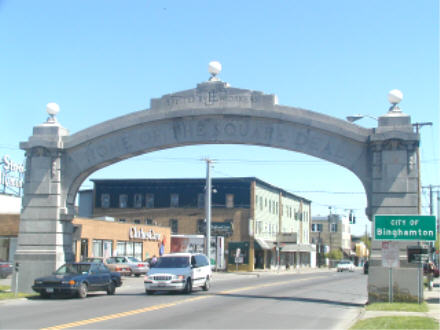
I wouldn't be surprised if there are skeptics to the above tale. To be honest, I wouldn't believe it either, except I grew up in Johnson City. I saw the huge factories, the parks, the libraries, the EJ clinics. I see the statues all around paying homage to the man who never shut his door to any worker in his company who had a gripe. They might not always have agreed with George F.'s decision, but the vast, vast majority believed they got a fair shake. And that's important to a person, it means they keep their dignity. And that's what I think the Square Deal was about, treating your fellow person, in what ever capacity you meet, with dignity. In the 1920's the workers in both Endicott and Johnson City got together and raised money to erect two large (at the time) arches across main street coming into the villages. Carved into stone on them is the phrase "Home of the Square Deal." they both still stand. It happened.
But my original quest was to find out what happened? After all, with all this success, one would think these methods and practices would have been replicated around the world? But they weren't. Why didn't the provable actions of the George F. Johnson continue on till this day? I'm not satisfied with the answers I've found so far, but they appear to be the best I can find.
George F. hated people receiving free money. They had to work for it. There was no free ride at EJ's, unless a worker met tragedy, illness, or old age. If a worker was too old, George F. would personally tell them he did not want to see them at the factory other than on pay day, when they received their full pay, every week. If a worker was sick, they had free medical, and would receive their full pay till they could return to the job. If a work died, their family would receive their full pay until the children were old enough to get work and support the family. But as for inheriting money, he thought it a sin. He refused to send his own son George W. Johnson to college, and instead put him to work at the lowest rung in the tanneries in Endicott. George W. worked his way up to president of the corporation, it was not handed to him.
I believe, over the years, as George F. Johnson's family became wealthy beyond their dreams, they might have drifted away from his primary tenet, in that workers and managers and owners, must live together in their communities. They must come to know each other as friends, neighbors, human beings. And I'm sure it the sheer size of their success has as much to do with it, after all, how can you personally know 19,000 workers? But when that connection is broken, when it's no longer "we" but rather "us and them." I believe that's when it breaks down.
In the end, it reminds me of something I've told my daughter over and over again through her childhood. At the end of the Disney cartoon, when the handsome prince and the damsel in distress ride off to live happily ever after, sure the peasants are happy. But what happens when their great-grand son becomes King, and turns out to be a real butt-hole? If you live at some one else's largess, you are doomed to their mercy.
Monday, May 22, 2006

Monday, May 01, 2006
Two colors of immigration
Immigration. The word to me brings to mind memories of old, faded, black and white photographs of long since passed relatives that were gone before I was even a twinkle in my old man's eye. My family is a family of immigrants. All branches, from all over Europe. There's Great Grandfather Seymour who joined the Union Army at age 14 with his older brother and father. Survived the war, settled in my home town, and proceeded to sire my grandfather at the ripe old age of 72. His mother was off the boat from Germany and I'm happy to say they both rest peacefully beneath the Civil War monument at a local cemetery.
My father's people came from Poland and Slovakia, brought to the US by the desire for a better life. I have a picture scanned from an old company newspaper showing all twelve of them. Most all of them shoe workers, brought to town - not by a New Deal - but rather George F. Johnson's promise of "Square Deal." That is, you work hard, and we'll be fair and honest with you. And by far that Square Deal seemed to hold, at least until the Johnson family decided to get out of the shoe business. The new owners weren't quite so enamored with a positive relationship between owner and worker.
My wife's lineage has been tracked back to Scotland and England in the seventeenth century. Her aunt wanted to join the Daughter's of the American Revolution, and that was a requirement.
My point is, even though being born in America and technically not an immigrant, I feel like one. My past is tied to memories of Polish and Slovak festivals, Irish dance festivals, extended families so large I couldn't remember them all if I did it for a living. Other Americans may not feel the same way, but like it or not, we're all immigrants. We all come from somewhere else. Some Native Americans and Latinos like to claim they are the original owners of this country and we should bow to them. Hate to break the news, but they are immigrants too. Current archeological academics believe humanity started in Africa, which means they immigrated here too, most likely across the "theorized" land bridge at the Bearing Straits.
By fact of being human, we all migrate. From house to house, from city to city, from state to state, from country to country, we humans are always in search of a better way, a better life, a Square Deal, where we can have a home, a job, a place to raise a family. It's human nature. And it's a good thing.
But there is a difference between legal immigration and illegal immigration. The former occurs when one follows the processes and procedures to achieve legal status to be in this country. It can be done. The fact that I'm alive to type this is proof enough. On the other hand, the fact that there are an estimated twelve million illegal immigrants in these United States is proof that you don't need to go through the proper channels.
As a Catholic, I've heard the declarations from Bishops who proclaim that everyone should be allowed in, and it's our duty as Christians to welcome strangers and those in need of help. I agree. But where do we draw the line? Unlimited opportunity and assistance will draw as many people for as long as the helping hand is extended.
As the child of immigrants, I have no problem with immigration. Personally I believe America needs them as much as they need America. After a few generations in America, people seem to get fat, dumb and happy, they start to fall into the entitlement mentality - a product of FDR's New Deal. America needs people hungry for success, thirsting for opportunity. It invigorates the rest of us. Reminds us of the promise America holds for us. Work hard, play by the rules, maybe get a little further than your parents, and pray you children make it a little further than you. After all, isn't that the American Dream?
But there is a difference between legal and illegal immigration. There's no doubt about it, no way to get around the issue. We've got twelve million of them in our country. They're our neighbors, our fellow workers, they sit next to us in the pews at Church on Sunday. There's no way Americans will stand for deporting twelve million people. The mere sight of armies of police rounding up twelve million people would cause such havoc, it just ain't going to happen. Even I can see that. The alternative is to grant amnesty to them, which only adds to the bait for more to come. As with most important issues, its far too complicated to be explained in the thirty seconds of so Bob Schieffer and the CBS Evening News will allot to it.
I don't have any answers to the above questions. But I do know this. America is an idea founded on the bedrock of individual freedom and responsibility, respect for our fellow Americans, and respect for the law. Just as some Americans cursed the arrival of my ancestors to "their" country, so do now some people curse the arrival of new immigrants, both legal and illegal. But as long as our new citizens, legal or illegal, can learn, understand, and follow the American dream, America will live on. Of that, I have no doubt.
My father's people came from Poland and Slovakia, brought to the US by the desire for a better life. I have a picture scanned from an old company newspaper showing all twelve of them. Most all of them shoe workers, brought to town - not by a New Deal - but rather George F. Johnson's promise of "Square Deal." That is, you work hard, and we'll be fair and honest with you. And by far that Square Deal seemed to hold, at least until the Johnson family decided to get out of the shoe business. The new owners weren't quite so enamored with a positive relationship between owner and worker.
My wife's lineage has been tracked back to Scotland and England in the seventeenth century. Her aunt wanted to join the Daughter's of the American Revolution, and that was a requirement.
My point is, even though being born in America and technically not an immigrant, I feel like one. My past is tied to memories of Polish and Slovak festivals, Irish dance festivals, extended families so large I couldn't remember them all if I did it for a living. Other Americans may not feel the same way, but like it or not, we're all immigrants. We all come from somewhere else. Some Native Americans and Latinos like to claim they are the original owners of this country and we should bow to them. Hate to break the news, but they are immigrants too. Current archeological academics believe humanity started in Africa, which means they immigrated here too, most likely across the "theorized" land bridge at the Bearing Straits.
By fact of being human, we all migrate. From house to house, from city to city, from state to state, from country to country, we humans are always in search of a better way, a better life, a Square Deal, where we can have a home, a job, a place to raise a family. It's human nature. And it's a good thing.
But there is a difference between legal immigration and illegal immigration. The former occurs when one follows the processes and procedures to achieve legal status to be in this country. It can be done. The fact that I'm alive to type this is proof enough. On the other hand, the fact that there are an estimated twelve million illegal immigrants in these United States is proof that you don't need to go through the proper channels.
As a Catholic, I've heard the declarations from Bishops who proclaim that everyone should be allowed in, and it's our duty as Christians to welcome strangers and those in need of help. I agree. But where do we draw the line? Unlimited opportunity and assistance will draw as many people for as long as the helping hand is extended.
As the child of immigrants, I have no problem with immigration. Personally I believe America needs them as much as they need America. After a few generations in America, people seem to get fat, dumb and happy, they start to fall into the entitlement mentality - a product of FDR's New Deal. America needs people hungry for success, thirsting for opportunity. It invigorates the rest of us. Reminds us of the promise America holds for us. Work hard, play by the rules, maybe get a little further than your parents, and pray you children make it a little further than you. After all, isn't that the American Dream?
But there is a difference between legal and illegal immigration. There's no doubt about it, no way to get around the issue. We've got twelve million of them in our country. They're our neighbors, our fellow workers, they sit next to us in the pews at Church on Sunday. There's no way Americans will stand for deporting twelve million people. The mere sight of armies of police rounding up twelve million people would cause such havoc, it just ain't going to happen. Even I can see that. The alternative is to grant amnesty to them, which only adds to the bait for more to come. As with most important issues, its far too complicated to be explained in the thirty seconds of so Bob Schieffer and the CBS Evening News will allot to it.
I don't have any answers to the above questions. But I do know this. America is an idea founded on the bedrock of individual freedom and responsibility, respect for our fellow Americans, and respect for the law. Just as some Americans cursed the arrival of my ancestors to "their" country, so do now some people curse the arrival of new immigrants, both legal and illegal. But as long as our new citizens, legal or illegal, can learn, understand, and follow the American dream, America will live on. Of that, I have no doubt.
Saturday, April 01, 2006
What makes a citizen?
One would have to be either an idiot, live under a rock, or be completely engrossed in reality TV to not have noticed the all the hubris lately concerning the state of illegal immigrants in these United States. Tens of thousands are protesting in the streets. Politicians of every conceivable color and stripe are glomming onto the media attention like the flesh-eating bacteria they are. And talking heads, bloggers and radio pundents have enough material to last them for years. Since there's absolutely nothing I can add to the conversation, that's exactly what I've decided to do. I'm stubborn like that. Drives my wife nuts.
But one aspect of my personality that my wife does appreciate is my ability to take a different perspective, a different twist, if you will. So here's one for all you readers, just what is an American citizen? The short answer is someone who is born in America or someone who becomes naturalized, i.e. jumps through all the hoops laid out by our well-oiled, streamlined, perfectly-functioning federal government. So how does the federal government secure the authority to bestow citizenship on certain people, while not on others? For that, let's take a little trip through this blog's favorite document - the United States Constitution.
On first glance, I must admit, there is really not much on the topic at all. The preamble begins with:
We the people of the United States, in order to form a more perfect union, establish justice, insure domestic tranquility, provide for the common defense, promote the general welfare, and secure the blessings of liberty to ourselves and our posterity, do ordain and establish this Constitution for the United States of America.
It appears to me that this is proclamation that we, the people living in the United States all those glorious decades ago, by virtue of having bothered the British enough to pack up and leave, makes us citizens of these states. However what I'm looking for is the meat and potatoes. What are the rights and, more importantly, the responsibilities required for citizenship? No doubt the Constitution by its very nature displays our rights as citizens by clearly stating (to all except the current and past few generations of socialists, communists, leftists and politicians) what the government can not do. And, in what it can not do, clearly states what our rights are. Namely, everything else. But what about the requirements? Let's dig further, shall we?
The legal status is slightly referenced again in the requirements for the office of the President, as outlined in Article II Section 1.
No person except a natural born citizen, or a citizen of the United States, at the time of the adoption of this Constitution, shall be eligible to the office of President; neither shall any person be eligible to that office who shall not have attained to the age of thirty five years, and been fourteen Years a resident within the United States.
The phrase "natural born citizen" leaps out, which would seem to proclaim citizenship on any one lucky enough to be born in this great country. Sucks to be you Arnold. But still, nothing definitive.
Surely the Thirteenth Amendment must hold something for us. After all, by abolishing slavery, clearly full citizenship was bestowed upon our fellow Americans so wronged by the disgusting and despicable institution of slavery. But on closer inspection, there really isn't all that much to be found.
Section 1. Neither slavery nor involuntary servitude, except as a punishment for crime whereof the party shall have been duly convicted, shall exist within the United States, or any place subject to their jurisdiction.
Section 2. Congress shall have power to enforce this article by appropriate legislation.
That just outlaws slavery, and doesn't even mention citizenship, it just codifies that freedom can not be seized without a trail by jury. The kicker I see here is this one seems to completely revoke the US authority to hold terrorists at Gitmo. After all, it is definitely under US jurisdiction. Fidel would most certainly be hosting parades, stuffing cigars in all their mouths and treating them as heroes if he had jurisdiction. But by the same thinking, since the amendment does not specifically state citizenship, did the US have the authority to hold German prisoners of war on US soil, during WWII? It would not appear not. Perhaps more than just the leftists find viewing the Constitution as a living, breathing document when it suits their needs.
So where do the rights, responsibilities and requirements of citizenship reside?
Article III, Section 3 deals with treason. But even that says nothing about revoking citizenship. I think I see where this is headed, and I don't get a warm fuzzy feeling on it. The only other place it could reside is Article I, Section 8, legislative power.
To make all laws which shall be necessary and proper for carrying into execution the foregoing powers, and all other powers vested by this Constitution in the government of the United States, or in any department or officer thereof.
In Highschool history class, the teacher explained this one as the "elasticity clause", but it could better be described as the overwhelming power Congress seizes on a daily basis to force their will on every single person in the United States, whenever they feel like it, simply because they are trying to compensate for early feelings of inadequacy and penis envy. I'm not sure of the exact scientific term for what Diane Fienstien, Nancy Pelosi, Hillary Clinton and other Congress-persons of the fairer sex have that causes them to consider themselves God's savior to the American people, but you get the idea.
This elasticity clause basically says Congress has the authority to pass any bill they see as necessary to carry out their responsibilities under the Constitution. Nice circular logic there, huh? Of course Congress does not have Constitutional authority to even debate public education, but (and that "but" is about the a trillion times the size of Alaska's North Slope) in order to fulfill their responsibilities, which are so clearly laid out, they must. And, after all, it's for the children! How could you even think about voting against someone who only has the children's best interest at heart? (Please ignore the 38,531 pages concerning casinos, ethanol subsidies, grants, loans, and other pork attached to the "No Child Shall Be Denied the Right to Have Multicultural Education Act" Move along, nothing to see here.)
In other words, Congress has decided what the rights, responsibilities and requirements for what is an American Citizen. Apparently none has the hueveros yet to try and put statutory limits on those born in the United States. But my guess is they've regulated every possible other thing.
So where does this leave us? With one crystal clear rule and a whole bunch of muddy murky, hazy rules. If you are born in the US, you are a citizen. If you leap through Congress' flaming hoops long enough, you can become a citizen. And if you cross the border in the dead of night, float on a raft through the Florida Straits, sneak onto a cargo freighter, or whatever, you are at Congress' mercy. And may the Lord have mercy on your soul.
But one aspect of my personality that my wife does appreciate is my ability to take a different perspective, a different twist, if you will. So here's one for all you readers, just what is an American citizen? The short answer is someone who is born in America or someone who becomes naturalized, i.e. jumps through all the hoops laid out by our well-oiled, streamlined, perfectly-functioning federal government. So how does the federal government secure the authority to bestow citizenship on certain people, while not on others? For that, let's take a little trip through this blog's favorite document - the United States Constitution.
On first glance, I must admit, there is really not much on the topic at all. The preamble begins with:
We the people of the United States, in order to form a more perfect union, establish justice, insure domestic tranquility, provide for the common defense, promote the general welfare, and secure the blessings of liberty to ourselves and our posterity, do ordain and establish this Constitution for the United States of America.
It appears to me that this is proclamation that we, the people living in the United States all those glorious decades ago, by virtue of having bothered the British enough to pack up and leave, makes us citizens of these states. However what I'm looking for is the meat and potatoes. What are the rights and, more importantly, the responsibilities required for citizenship? No doubt the Constitution by its very nature displays our rights as citizens by clearly stating (to all except the current and past few generations of socialists, communists, leftists and politicians) what the government can not do. And, in what it can not do, clearly states what our rights are. Namely, everything else. But what about the requirements? Let's dig further, shall we?
The legal status is slightly referenced again in the requirements for the office of the President, as outlined in Article II Section 1.
No person except a natural born citizen, or a citizen of the United States, at the time of the adoption of this Constitution, shall be eligible to the office of President; neither shall any person be eligible to that office who shall not have attained to the age of thirty five years, and been fourteen Years a resident within the United States.
The phrase "natural born citizen" leaps out, which would seem to proclaim citizenship on any one lucky enough to be born in this great country. Sucks to be you Arnold. But still, nothing definitive.
Surely the Thirteenth Amendment must hold something for us. After all, by abolishing slavery, clearly full citizenship was bestowed upon our fellow Americans so wronged by the disgusting and despicable institution of slavery. But on closer inspection, there really isn't all that much to be found.
Section 1. Neither slavery nor involuntary servitude, except as a punishment for crime whereof the party shall have been duly convicted, shall exist within the United States, or any place subject to their jurisdiction.
Section 2. Congress shall have power to enforce this article by appropriate legislation.
That just outlaws slavery, and doesn't even mention citizenship, it just codifies that freedom can not be seized without a trail by jury. The kicker I see here is this one seems to completely revoke the US authority to hold terrorists at Gitmo. After all, it is definitely under US jurisdiction. Fidel would most certainly be hosting parades, stuffing cigars in all their mouths and treating them as heroes if he had jurisdiction. But by the same thinking, since the amendment does not specifically state citizenship, did the US have the authority to hold German prisoners of war on US soil, during WWII? It would not appear not. Perhaps more than just the leftists find viewing the Constitution as a living, breathing document when it suits their needs.
So where do the rights, responsibilities and requirements of citizenship reside?
Article III, Section 3 deals with treason. But even that says nothing about revoking citizenship. I think I see where this is headed, and I don't get a warm fuzzy feeling on it. The only other place it could reside is Article I, Section 8, legislative power.
To make all laws which shall be necessary and proper for carrying into execution the foregoing powers, and all other powers vested by this Constitution in the government of the United States, or in any department or officer thereof.
In Highschool history class, the teacher explained this one as the "elasticity clause", but it could better be described as the overwhelming power Congress seizes on a daily basis to force their will on every single person in the United States, whenever they feel like it, simply because they are trying to compensate for early feelings of inadequacy and penis envy. I'm not sure of the exact scientific term for what Diane Fienstien, Nancy Pelosi, Hillary Clinton and other Congress-persons of the fairer sex have that causes them to consider themselves God's savior to the American people, but you get the idea.
This elasticity clause basically says Congress has the authority to pass any bill they see as necessary to carry out their responsibilities under the Constitution. Nice circular logic there, huh? Of course Congress does not have Constitutional authority to even debate public education, but (and that "but" is about the a trillion times the size of Alaska's North Slope) in order to fulfill their responsibilities, which are so clearly laid out, they must. And, after all, it's for the children! How could you even think about voting against someone who only has the children's best interest at heart? (Please ignore the 38,531 pages concerning casinos, ethanol subsidies, grants, loans, and other pork attached to the "No Child Shall Be Denied the Right to Have Multicultural Education Act" Move along, nothing to see here.)
In other words, Congress has decided what the rights, responsibilities and requirements for what is an American Citizen. Apparently none has the hueveros yet to try and put statutory limits on those born in the United States. But my guess is they've regulated every possible other thing.
So where does this leave us? With one crystal clear rule and a whole bunch of muddy murky, hazy rules. If you are born in the US, you are a citizen. If you leap through Congress' flaming hoops long enough, you can become a citizen. And if you cross the border in the dead of night, float on a raft through the Florida Straits, sneak onto a cargo freighter, or whatever, you are at Congress' mercy. And may the Lord have mercy on your soul.
Thursday, March 23, 2006
Rush Limbaugh - Your Nation Needs You!
A few weeks, or maybe it was a few months ago, I can't keep track, Maureen Dowd released a column in advance of a new book that laid out the problem faced by all modern, progressive, liberal, democratic, happening, hip, cool, and whatever, women. Having forsaken the concept of traditional marriage and family life in search of the greater glory of fame, fortune and the brass ring, upon reaching their ultimate goal, they are unable to find suitable mates. How and why could this happen? After all, aren't they successful? Aren't they on the party "A" list? Don't they get invited to all the coolest parties? What could possibly prevent them from being "hunk magnets" and securing the ultimate prize they so richly deserve? According to Dowd, it's because their male counterparts (hip, cool, rich, well-read, etc.) prefer dumb blondes, secretaries, and service workers. I'm not sure if she actually used the term "intimidated" as I can rarely get past Dowd's first few paragraphs, but that's what I suspect she's driving at. In other words, while the progressive, feminist has gone out and conquered the modern metro world, the hunks they were expecting to be waiting at the finish line have decided "bimbos" are easier to get along with.
Let's skim past the obvious, that perhaps men prefer women who have more varied desires than the board room. Lets ignore the possibility that perhaps the hunks she feels she deserves might have met other women on the journey through life and weren't actually standing around waiting at the finish line, and in fact, they have lives. Let's get beyond what is plain to every one who's ever had a successful relationship and realizes that when it comes to significant others, life is not a buffet where one picks and chooses the traits they demand from a spouse: "he must enjoy poetry, sailing, fine cuisine and 'Sex in the City'", but rather an off-the-rack world where you don't force someone to meet your demands, but rather accept each other, warts and all, because you actually love them.
No, we'll leave that in the bit bucket for now. Instead, lets move on towards an answer to solve these problems. And the problems are many. Turn on any liberal news radio network or liberal news TV program, and you will see just how dire this situation is. Immaculately dressed women, hair perfect, visions of grace, intelligence, poise and confidence, and you will immediately see a common thread. They hate conservatives. They rip them to shreds every chance they get. They slowly roast their chestnuts over the open fire of their commentary. They belittle them, humiliate them, make fun of them, insult them, and laugh in the face of any one who doesn't immediately see the absolute correctness of their position. And, having plied the troubled waters of relationships, I know that look. I've seen it before. It's when a women on a date literally spits fire describing who they'd really rather be dating. They need "it."
The only way I can see to bring some kind of civility to the airwaves between liberal-democratic women and conservatives, is for "it" to take place. And I think I type for both sexes, when I coyly refer to "it". We know, because we all know what "it" is. We've all been there before. Be honest. Admit it. We all want "it."
I don't know about females of my age bracket (tail end of baby boomers) but I know every male geek of my day remembers the classic "Revenge of the Nerds". When the head cheer leader falls for the geek, justice was served. If only she would have shut her mouth and opened her eyes sooner, she would have entered the promised land so much earlier in her life. But no, she was restrained by peer pressure. But peer pressure does not allow for one's true desire, it only allows for the desire of the pack one runs with. And that was "no nerds." How silly labels truly are.
Not I'm not suggesting in the least that Rush Limbaugh is a nerd, no - not at all. Rather I'm just using the analogy of "Revenge of the Nerds" to make a point. And guys, I need you to back me up on this, I'm pretty darned sure I'm right. Most women want what they can't have. If you treat them nice, give them respect, they walk all over you and want something else. Be a little uppity, let them know you're still deciding, and they love the challenge. My opinion is, regardless of what Maureen Dowd and her crowd says, we know what they want, and that's what they claim to despise. That's why we need Rush.
Some man on the conservative side needs to seize the initiative, needs to stake a claim in this virgin territory. Friends, that person is Rush Limbaugh.
[Editor's note: The paragraph below makes it way too easy to come up with highly inappropriate links, so I shall be the better person and resist]
I know it won't be easy. It very well may turn out to be down right ugly. But the attempt must be made. Rush needs to be the stand up guy he is. He needs to ride forth into this heard of liberal women. He needs to lead the thrust into enemy territory. He needs to drive home the message of fiscal conservatism. Certainly they will fight back, but he needs to keep pounding these principles home. He needs to do it over, and over, and over, till the message really hits pay dirt. He will be openly mocked for his views on "small government" but he mustn't let that deter him. Rather he must stand tall by his convictions. He must over come their defenses, he must succeed in implanting his conservative ideals in unplowed fields, so the seed of liberty and freedom might grow in this new, fertile ground. And in doing so, Rush will become a symbol to all of us with similar desires and ideals, of the promise of what America should truly be. And he must continue to perform till the ranks of conservative men have the courage to follow him, over the top of the liberal trench, through no-man's land, literally bursting with optimism and ideology, to join him on this crusade. And together we can satisfy the emotional needs that prevent liberal, feminist women from seeing the truth.
Rush, we need you. Maureen Dowd needs you. You're nation needs you. Rise to the occasion!
Let's skim past the obvious, that perhaps men prefer women who have more varied desires than the board room. Lets ignore the possibility that perhaps the hunks she feels she deserves might have met other women on the journey through life and weren't actually standing around waiting at the finish line, and in fact, they have lives. Let's get beyond what is plain to every one who's ever had a successful relationship and realizes that when it comes to significant others, life is not a buffet where one picks and chooses the traits they demand from a spouse: "he must enjoy poetry, sailing, fine cuisine and 'Sex in the City'", but rather an off-the-rack world where you don't force someone to meet your demands, but rather accept each other, warts and all, because you actually love them.
No, we'll leave that in the bit bucket for now. Instead, lets move on towards an answer to solve these problems. And the problems are many. Turn on any liberal news radio network or liberal news TV program, and you will see just how dire this situation is. Immaculately dressed women, hair perfect, visions of grace, intelligence, poise and confidence, and you will immediately see a common thread. They hate conservatives. They rip them to shreds every chance they get. They slowly roast their chestnuts over the open fire of their commentary. They belittle them, humiliate them, make fun of them, insult them, and laugh in the face of any one who doesn't immediately see the absolute correctness of their position. And, having plied the troubled waters of relationships, I know that look. I've seen it before. It's when a women on a date literally spits fire describing who they'd really rather be dating. They need "it."
The only way I can see to bring some kind of civility to the airwaves between liberal-democratic women and conservatives, is for "it" to take place. And I think I type for both sexes, when I coyly refer to "it". We know, because we all know what "it" is. We've all been there before. Be honest. Admit it. We all want "it."
I don't know about females of my age bracket (tail end of baby boomers) but I know every male geek of my day remembers the classic "Revenge of the Nerds". When the head cheer leader falls for the geek, justice was served. If only she would have shut her mouth and opened her eyes sooner, she would have entered the promised land so much earlier in her life. But no, she was restrained by peer pressure. But peer pressure does not allow for one's true desire, it only allows for the desire of the pack one runs with. And that was "no nerds." How silly labels truly are.
Not I'm not suggesting in the least that Rush Limbaugh is a nerd, no - not at all. Rather I'm just using the analogy of "Revenge of the Nerds" to make a point. And guys, I need you to back me up on this, I'm pretty darned sure I'm right. Most women want what they can't have. If you treat them nice, give them respect, they walk all over you and want something else. Be a little uppity, let them know you're still deciding, and they love the challenge. My opinion is, regardless of what Maureen Dowd and her crowd says, we know what they want, and that's what they claim to despise. That's why we need Rush.
Some man on the conservative side needs to seize the initiative, needs to stake a claim in this virgin territory. Friends, that person is Rush Limbaugh.
[Editor's note: The paragraph below makes it way too easy to come up with highly inappropriate links, so I shall be the better person and resist]
I know it won't be easy. It very well may turn out to be down right ugly. But the attempt must be made. Rush needs to be the stand up guy he is. He needs to ride forth into this heard of liberal women. He needs to lead the thrust into enemy territory. He needs to drive home the message of fiscal conservatism. Certainly they will fight back, but he needs to keep pounding these principles home. He needs to do it over, and over, and over, till the message really hits pay dirt. He will be openly mocked for his views on "small government" but he mustn't let that deter him. Rather he must stand tall by his convictions. He must over come their defenses, he must succeed in implanting his conservative ideals in unplowed fields, so the seed of liberty and freedom might grow in this new, fertile ground. And in doing so, Rush will become a symbol to all of us with similar desires and ideals, of the promise of what America should truly be. And he must continue to perform till the ranks of conservative men have the courage to follow him, over the top of the liberal trench, through no-man's land, literally bursting with optimism and ideology, to join him on this crusade. And together we can satisfy the emotional needs that prevent liberal, feminist women from seeing the truth.
Rush, we need you. Maureen Dowd needs you. You're nation needs you. Rise to the occasion!
Subscribe to:
Posts (Atom)